> ## Documentation Index
> Fetch the complete documentation index at: https://docs.noimosai.com/llms.txt
> Use this file to discover all available pages before exploring further.
# Research Competitors
> Research competing agencies and specialists, then use the findings to improve your services, positioning, and marketing.
Ongoing competitor research reveals which providers prospective clients compare and which criteria shape the decision. Use the findings to improve service pages, case studies, articles, social posts, and positioning. In NoimosAI, register relevant competitors, monitor public changes, and turn each important finding into an action your team can implement.
There are two main tasks in competitor research.
1. Decide which competitors to compare
2. Monitor competitor changes and turn findings into improvements
First, review the comparison targets and evaluation criteria in [Understand the basics of competitor research](#basics), then learn how to register competitors and set up regular monitoring in [Research competitors with NoimosAI](#practice).
## Understand the basics of competitor research
In competitor research, the goal is not to copy other companies’ wording but to identify the selection criteria customers use and the areas of expertise your company should emphasize. Check not only services with the same name but also alternative options that solve the same problem in different ways.
### 1. Decide which competitors to compare
For client and professional services, competitors include not only firms offering the same service but also other support options or in-house options customers may choose to solve the same problem. The table below divides comparison targets into three types and helps you include options that are easy to overlook.
| Types of competitors from the customer's perspective | Why include them as comparison targets | Examples for client and professional services |
| ---------------------------------------------------- | ------------------------------------------------------------------ | --------------------------------------------------------------------------------- |
| Direct competitors | Provide support in the same domain to the same customers | Peer production companies, development firms, consultants, licensed professionals |
| Indirect competitors | Support the same problem with a different setup or delivery method | Large firms vs. individual specialists, generalist firms vs. specialized firms |
| Alternatives | Address the problem without outsourcing | In-house teams, hiring, software, postponing action |
Choose 3–5 companies customers are likely to actually compare and compare them on the same criteria. Prioritize companies mentioned during inquiries, companies shown together in search results or comparison sites, and companies whose target customers and service areas are similar to yours.
| Comparison item | What to check |
| ------------------------------ | -------------------------------------------------------------------------------------------- |
| Target customers | Industry, size, region, contact person, problems they face |
| Area of expertise | Strong domains, types of work they handle, what they don’t handle |
| Delivery method | Services offered, deliverables, timeline, team structure, customer-side preparation required |
| Pricing and contracts | Pricing ranges, pricing units, minimum amounts, contract duration, additional fees |
| Client results and credibility | Case studies, outcomes, team experience, certifications, and reviews |
| Customer touchpoints | Website, search, AI search, social media, referrals, events |
### 2. Monitor competitor changes and turn findings into improvements
Once you’ve selected competitors, regularly check for changes in services, pricing, case studies, staff, articles, and social posts. Identify what changed since the last check and which customer problems your company is missing, then decide on concrete actions.
| Changes found in competitor research | Actions your company should verify and implement |
| ------------------------------------------------------------------------------------------- | ---------------------------------------------------------------------------------------------------------------------------------------- |
| A competitor gained top search rankings and we don’t have a page answering the same problem | Confirm whether the keyword is relevant to our target customers and create an article that includes our unique experience and procedures |
| A competitor’s case study is getting a strong response | Determine whether the problem, results, or presentation drove engagement and create articles or posts using our own case studies |
| A new service or pricing was published | Check whether customers’ comparison criteria have changed and update service pages, pricing explanations, and FAQs |
| Case studies in a specific industry are increasing | Verify whether the competitor is expanding their target market and reassess our company’s strengths and target customers |
| Customers express dissatisfaction with a competitor’s approach or results | Confirm whether the dissatisfaction applies to our target customers and clearly explain our approach and scope of service |
Record the publication or verification date and the source URL, and separate verified facts from speculation. Estimated traffic for competitor sites should be treated as trend information, not exact visitor counts.
## Research competitors with NoimosAI
Register the competitors you want to compare and create an agent that turns competitor changes into improvements to your content and website.
For instructions on entering a prompt in chat, see [Enter your own prompt](/help-center/chat/enter-your-own-prompt).
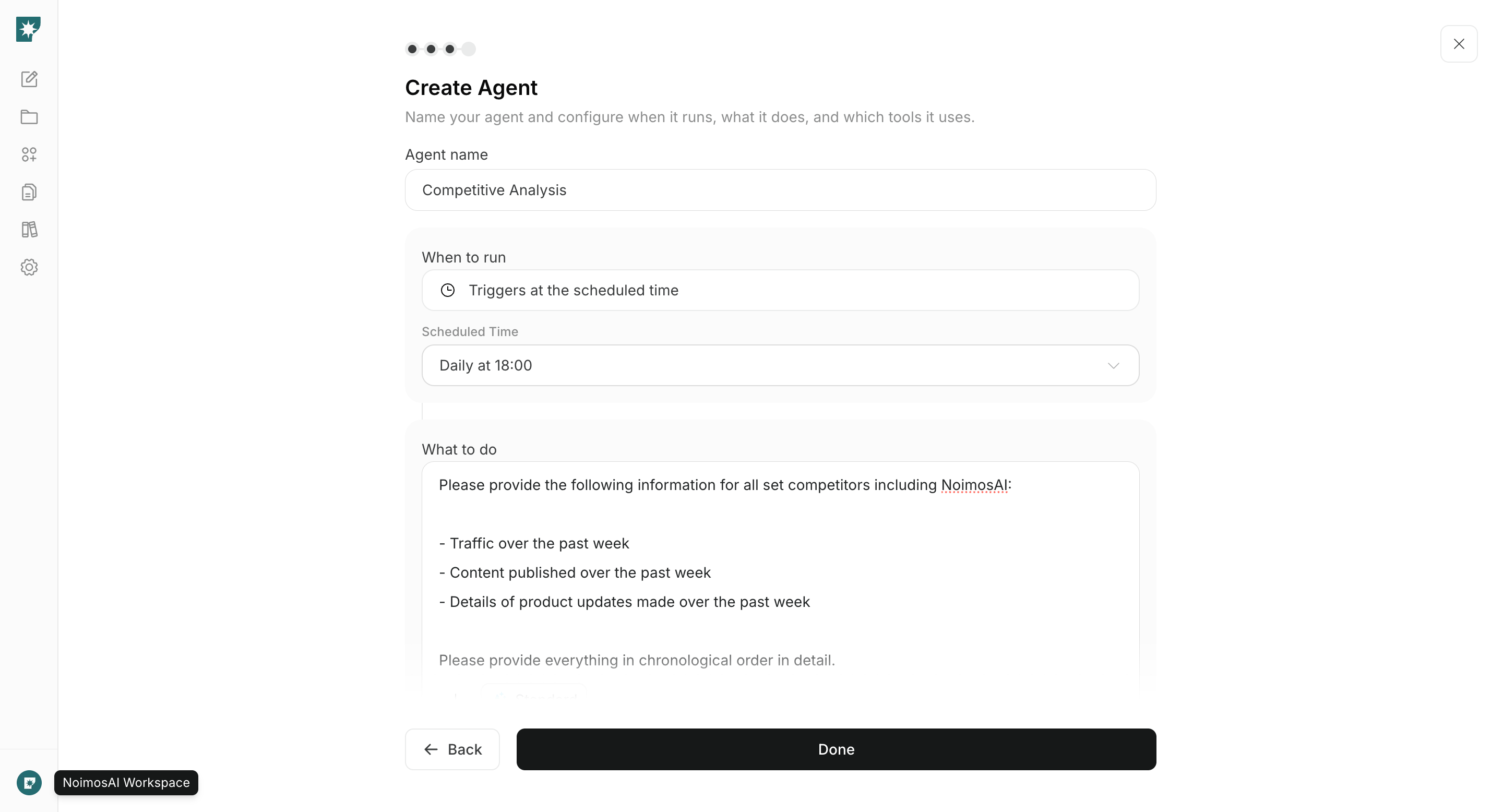
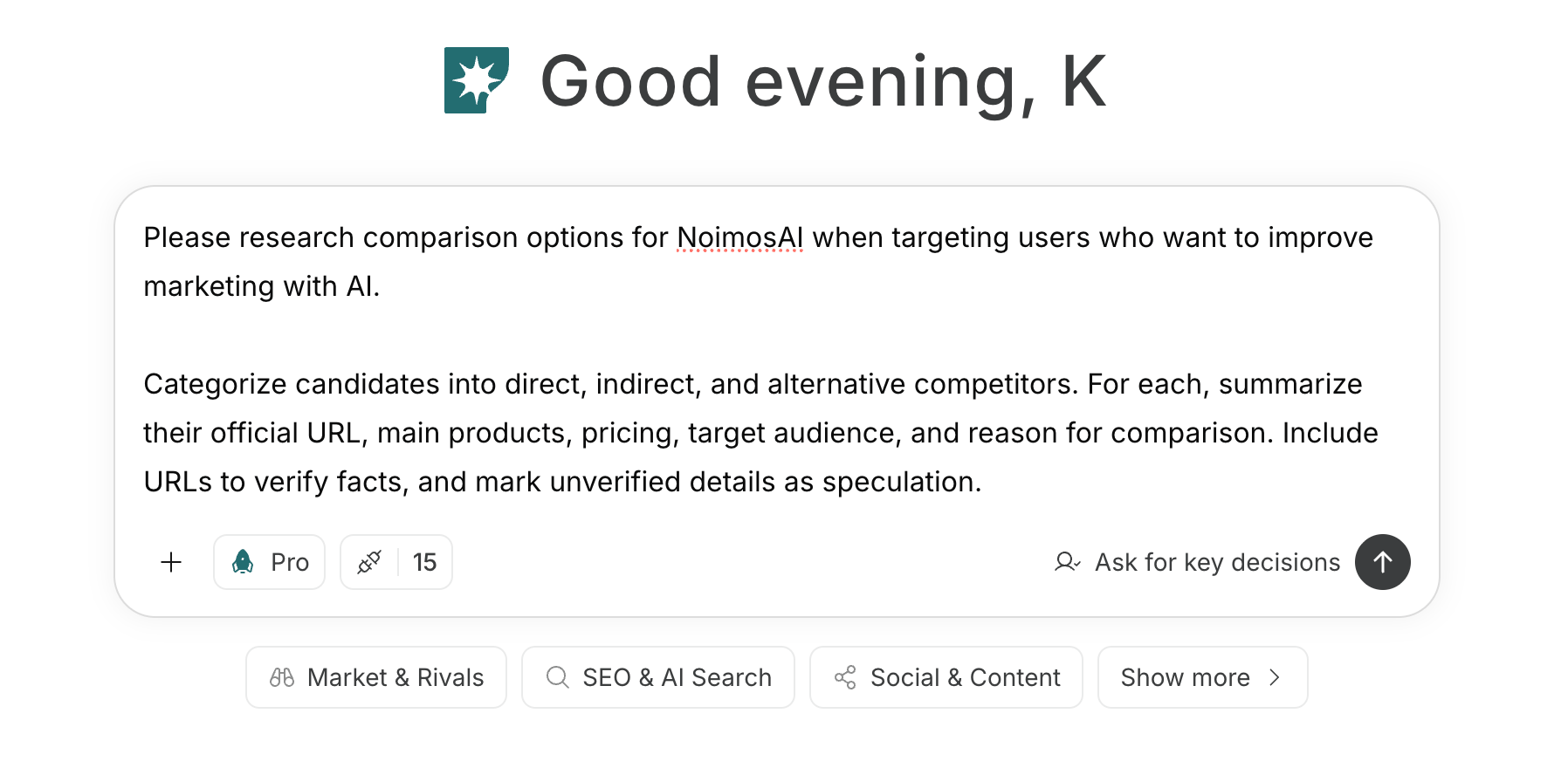 If you want to create an agent by providing the objective and conditions in a prompt, see [Create an agent from chat](/help-center/ai-team/create-a-trigger-from-chat). To manually enter each setting on the setup screen, see [Create an agent from scratch](/help-center/ai-team/create-an-agent-from-scratch).
 ### 1. Decide which competitors to compare
If you haven’t decided on competitors, enter your company’s service, target customers, the problem you solve, and the geographic area into chat. Classify candidates into direct competitors, businesses that solve the same problem in a different way, and alternatives such as in-house solutions, then choose candidates with clear reasons for comparison.
#### Prompt for chat
```text theme={null}
For [your company’s service], investigate the options [target customers] compare when solving [the problem].
Divide the results into direct competitors, indirect competitors, and alternatives such as in-house solutions, hiring, and software. For each candidate, list the official URL, target customers, main services, pricing, client results, and reasons they are a relevant comparison. Separate items you cannot confirm as assumptions.
```
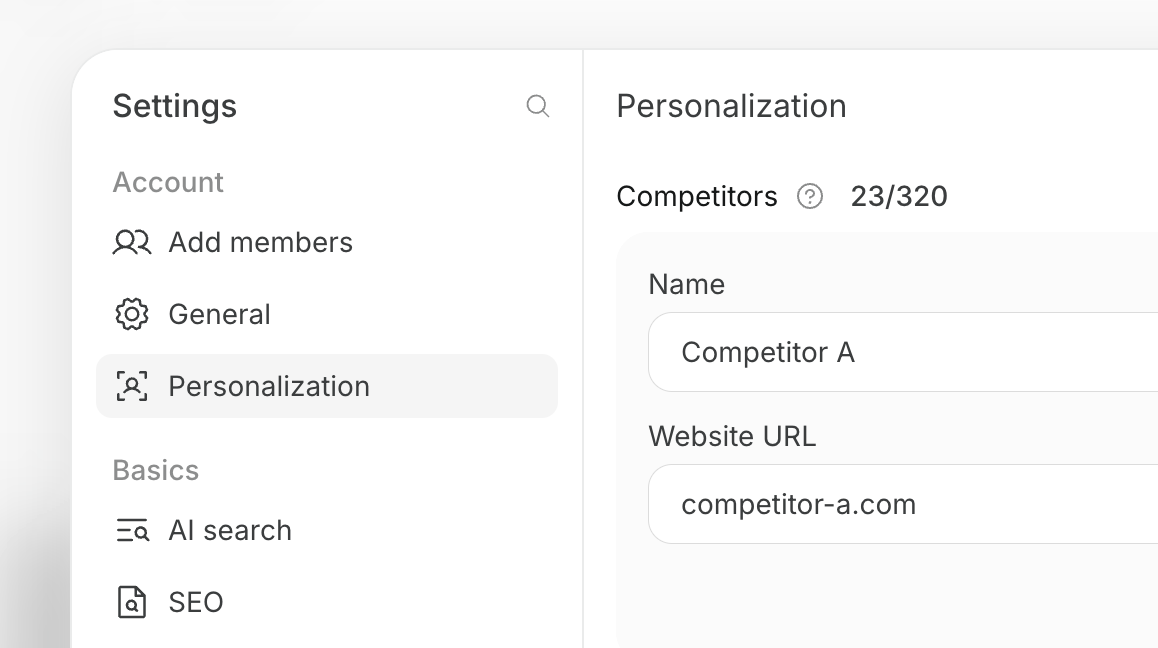
From the candidates, select 3–5 companies based on the likelihood that target customers will actually compare them and the potential impact on your company. Register the selected competitors by opening Settings → Personalization in the target workspace and adding them under Competitors.
### 1. Decide which competitors to compare
If you haven’t decided on competitors, enter your company’s service, target customers, the problem you solve, and the geographic area into chat. Classify candidates into direct competitors, businesses that solve the same problem in a different way, and alternatives such as in-house solutions, then choose candidates with clear reasons for comparison.
#### Prompt for chat
```text theme={null}
For [your company’s service], investigate the options [target customers] compare when solving [the problem].
Divide the results into direct competitors, indirect competitors, and alternatives such as in-house solutions, hiring, and software. For each candidate, list the official URL, target customers, main services, pricing, client results, and reasons they are a relevant comparison. Separate items you cannot confirm as assumptions.
```
From the candidates, select 3–5 companies based on the likelihood that target customers will actually compare them and the potential impact on your company. Register the selected competitors by opening Settings → Personalization in the target workspace and adding them under Competitors.
 ### 2. Monitor competitor changes and turn findings into improvements
Create an agent that checks registered competitors for changes and turns important opportunities into improvements such as articles, posts, or updated service pages. Typically start weekly; for areas with fewer changes, begin with monthly checks.
#### Agent setup
**Trigger:** Schedule / Weekly
**Instructions:**
```text theme={null}
For the competitors registered in this workspace’s Personalization and for our company, investigate services, pricing, case studies and client outcomes, staff, articles, videos, social posts, and important announcements published since the last investigation.
Identify the following opportunities and organize them with source URLs:
- Keywords where competitors rank highly in search and we are missing related pages that are highly relevant to our target customers
- Topics where competitors are getting strong engagement and we can uniquely publish using our expertise and client results
- Changes to services, pricing, client results, or scope of service that affect customer comparisons and purchase decisions
For the most important opportunity, create a final draft for an article, social post, or updated service page that our company can publish.
```
**Integrations:** None
In the results, verify source URLs, dates, service details, pricing, and case-study claims. Before publishing, make sure the draft matches your company’s actual experience and scope. Then monitor the metric the change is intended to affect, such as search traffic, service-page views, or inquiries.
## Related pages
* [Create and improve a website](/playbooks/client-services/build-website)
* [Increase search traffic with SEO](/playbooks/client-services/seo)
* [Manage social media](/playbooks/client-services/sns)
### 2. Monitor competitor changes and turn findings into improvements
Create an agent that checks registered competitors for changes and turns important opportunities into improvements such as articles, posts, or updated service pages. Typically start weekly; for areas with fewer changes, begin with monthly checks.
#### Agent setup
**Trigger:** Schedule / Weekly
**Instructions:**
```text theme={null}
For the competitors registered in this workspace’s Personalization and for our company, investigate services, pricing, case studies and client outcomes, staff, articles, videos, social posts, and important announcements published since the last investigation.
Identify the following opportunities and organize them with source URLs:
- Keywords where competitors rank highly in search and we are missing related pages that are highly relevant to our target customers
- Topics where competitors are getting strong engagement and we can uniquely publish using our expertise and client results
- Changes to services, pricing, client results, or scope of service that affect customer comparisons and purchase decisions
For the most important opportunity, create a final draft for an article, social post, or updated service page that our company can publish.
```
**Integrations:** None
In the results, verify source URLs, dates, service details, pricing, and case-study claims. Before publishing, make sure the draft matches your company’s actual experience and scope. Then monitor the metric the change is intended to affect, such as search traffic, service-page views, or inquiries.
## Related pages
* [Create and improve a website](/playbooks/client-services/build-website)
* [Increase search traffic with SEO](/playbooks/client-services/seo)
* [Manage social media](/playbooks/client-services/sns)