> ## Documentation Index
> Fetch the complete documentation index at: https://docs.noimosai.com/llms.txt
> Use this file to discover all available pages before exploring further.
# Research Competitors
> Research competitors’ products and marketing, then use the findings to improve your own products, content, and campaigns.
Ongoing competitor research helps you make evidence-based improvements to product pages, content, campaigns, and the offer itself. In NoimosAI, register the competitors that matter, monitor changes in public information, and turn the most relevant finding into a specific action.
Competitor research has two parts.
1. Decide which competitors to compare
2. Monitor competitor changes and turn findings into improvements
Start with [Understand the basics of competitor research](#basics) to learn how to select competitors and act on the findings. Then follow [Research competitors with NoimosAI](#practice) to register competitors and set up recurring monitoring.
## Understand the basics of competitor research
Competitor research is not a way to copy another brand’s tactics. It reveals which products or alternatives customers compare, which criteria they use, and where your product or explanation needs to improve.
### 1. Decide which competitors to compare
Competitors are not only brands selling the same type of product. Options that satisfy the same customer need with different products or methods are also considered competitors.
| Type | Meaning | Example |
| ------------------- | ------------------------------------------------------------------ | ------------------------------------------------------------------- |
| Direct competitor | Provides the same type of product or service to the same customers | Products in the same category, services in the same geographic area |
| Indirect competitor | Fulfills the same need with different products or delivery methods | Store vs. delivery, purchase vs. rental, staffed service vs. app |
| Alternative | Achieves the goal without purchasing the product | DIY, free information, continuing current method |
Choose 3–5 companies that customers are likely to compare and compare them on the same items. If you include too many competitors you won’t be able to track changes, so prioritize brands that are frequently mentioned at purchase time and brands that have a large impact on your business.
| Comparison item | What to check |
| ------------------------------------ | ---------------------------------------------------------------------- |
| Target customers and usage scenarios | Who uses it and what problems or goals they have |
| Products and pricing | Product lineup, prices, sizes, plans, shipping, reservation terms |
| Reasons for being chosen | Which value is communicated first and what evidence supports it |
| Purchase conditions | Discounts, first-time offers, guarantees, return/cancellation policies |
| Trust factors | Reviews, proven results, expert explanations, third-party evaluations |
| Customer touchpoints | Website, stores, marketplaces, search, social media, ads |
### 2. Monitor competitor changes and turn findings into improvements
Once you’ve chosen competitors, periodically check changes in new products, pricing, product pages, search results, social posts, etc. Instead of re-laying out all information each time, look for what changed since the last check and opportunities your company hasn’t yet addressed.
Research results only become useful once you decide the next actions to take. The table below pairs changes found in competitor research with responses your company should confirm and then execute.
| Change found in competitor research | What to check and do next |
| ------------------------------------------------------------------------------------------- | --------------------------------------------------------------------------------------------------------------------------------------------- |
| A competitor’s article ranks high in search, and we don’t have an article on the same topic | Confirm whether this search topic is relevant to our customers, then create an SEO article using our products and experience |
| A competitor’s post is getting strong engagement | Check which of theme, format, or opening presentation drove engagement, and create a post adding our unique information |
| A new product, price, or promotion was announced | Confirm whether comparison criteria or customer choice factors change, and update product pages, price explanations, and FAQs |
| The same complaint appears repeatedly in reviews | Determine whether we can address the underlying issue, then update product descriptions, guarantees, or post-purchase guidance as appropriate |
When recording information, note the publication date or check date and the supporting URL. Separate confirmed facts from assumptions, and treat estimated data such as competitor site traffic as indicators of trends rather than exact visit counts.
## Research competitors with NoimosAI
Register the competitors you want to compare in NoimosAI, then create agents that turn relevant competitor changes into specific improvements to your content and pages.
For instructions on entering a prompt in chat, see [Enter your own prompt](/help-center/chat/enter-your-own-prompt).
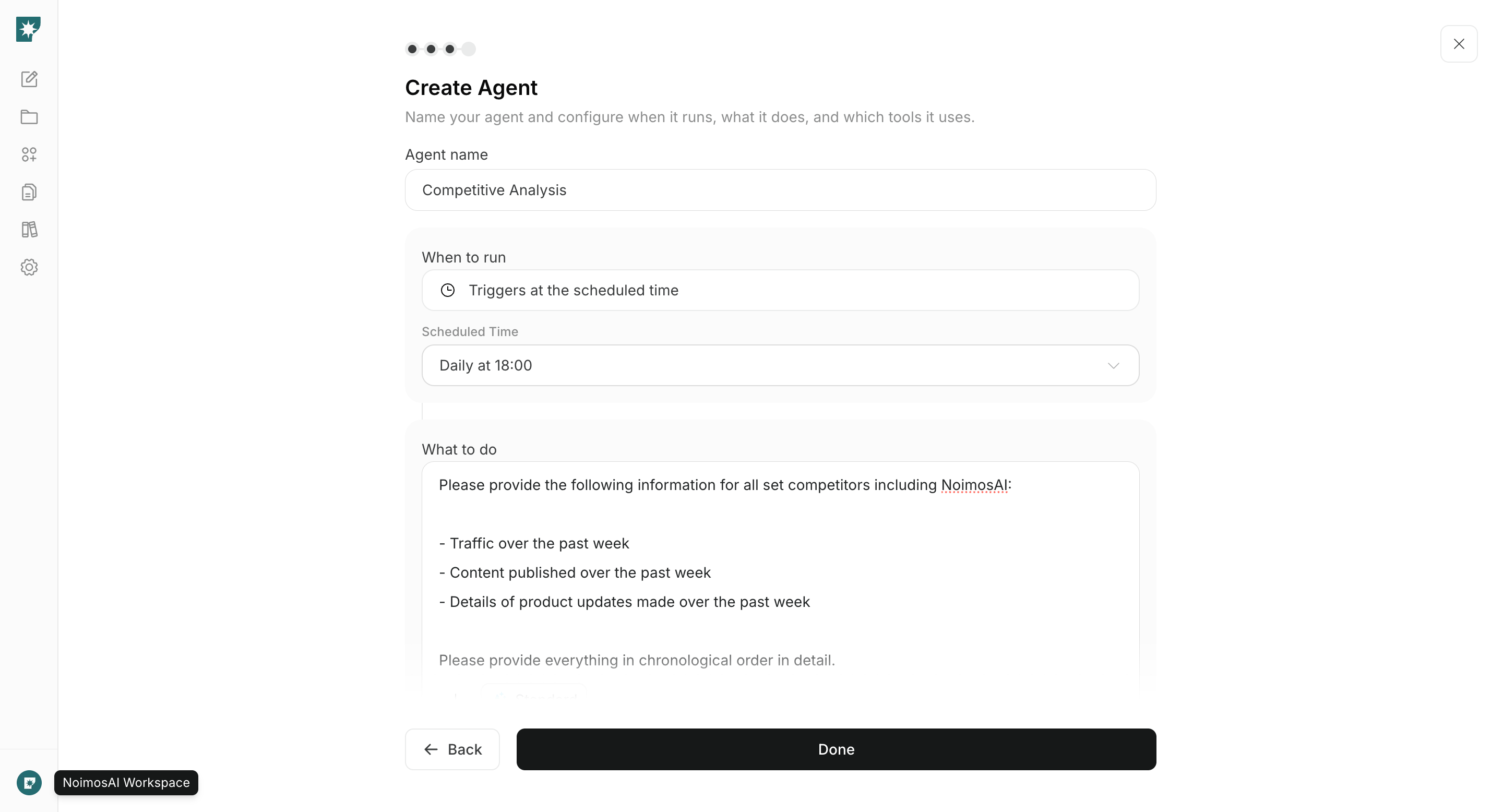
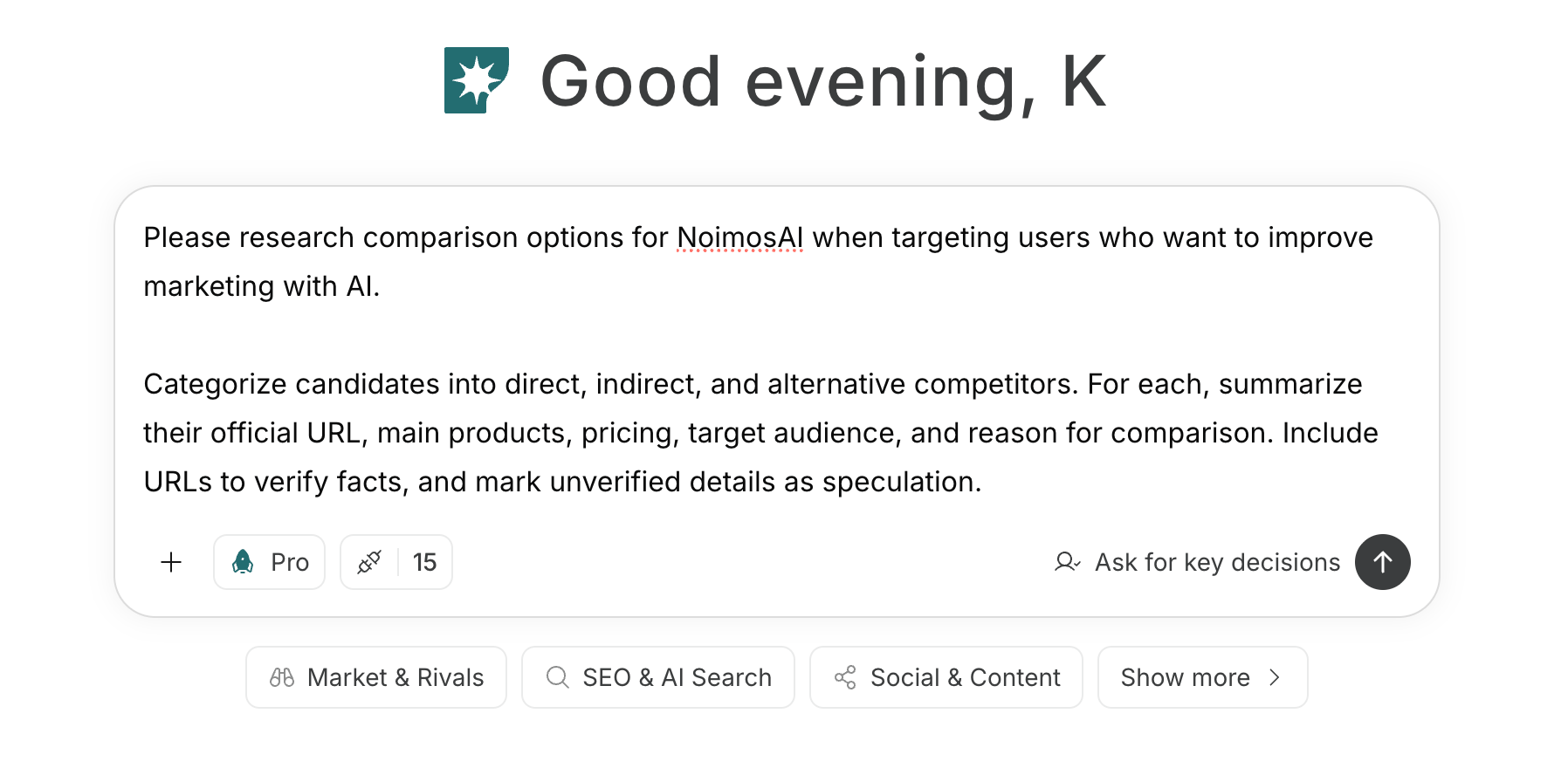 To create an agent by describing its goal and conditions in a prompt, see [Create an agent from chat](/help-center/ai-team/create-a-trigger-from-chat). To enter each setting manually, see [Create an agent from scratch](/help-center/ai-team/create-an-agent-from-scratch).
 ### 1. Decide which competitors to compare
If you haven’t decided competitors, enter your product, target customers, usage scenarios, and sales regions into chat to organize candidate competitors.
#### Prompt to organize competitor candidates
```text theme={null}
For [our product/service], investigate options that target customers compare when using for [usage scenario or goal].
Divide into direct competitors, indirect competitors, and alternatives. For each candidate, list the official URL, main products, price range, target customers, and reasons they would be compared. Provide URLs that verify facts, and separate items that cannot be verified as assumptions.
```
From the candidates, select 3–5 companies based on the likelihood customers will actually compare them and their impact on your business. Exclude brands that customers won’t compare due to different regions or sales channels.
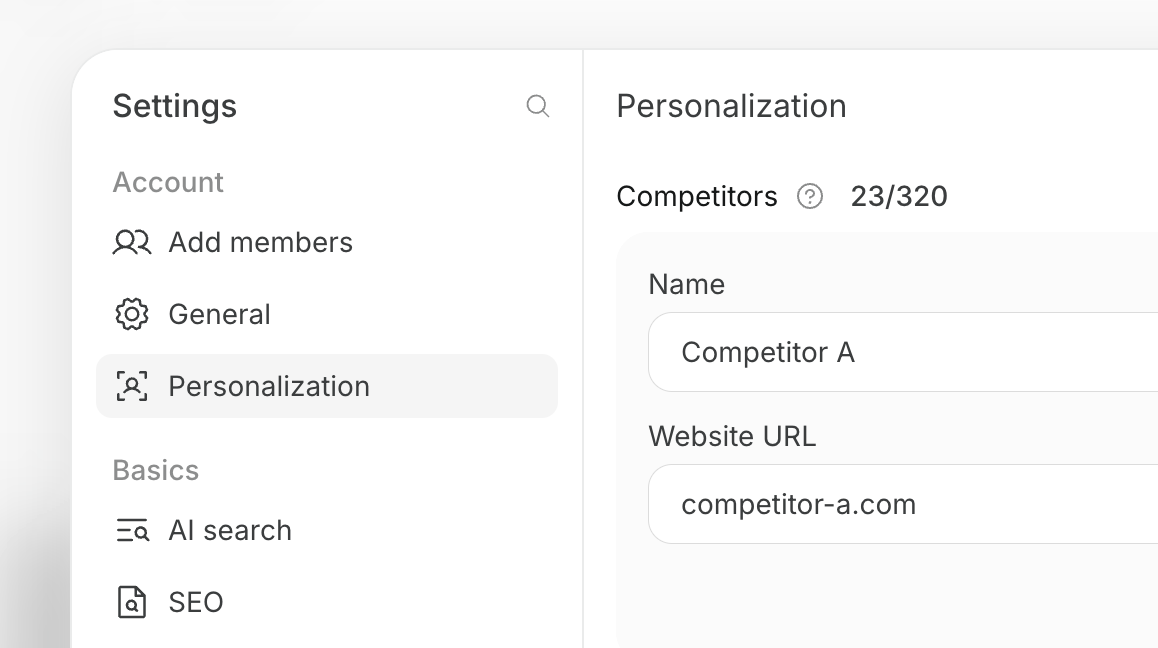
Register selected competitors in the target workspace by opening Settings → Personalization and adding them under Competitors.
### 1. Decide which competitors to compare
If you haven’t decided competitors, enter your product, target customers, usage scenarios, and sales regions into chat to organize candidate competitors.
#### Prompt to organize competitor candidates
```text theme={null}
For [our product/service], investigate options that target customers compare when using for [usage scenario or goal].
Divide into direct competitors, indirect competitors, and alternatives. For each candidate, list the official URL, main products, price range, target customers, and reasons they would be compared. Provide URLs that verify facts, and separate items that cannot be verified as assumptions.
```
From the candidates, select 3–5 companies based on the likelihood customers will actually compare them and their impact on your business. Exclude brands that customers won’t compare due to different regions or sales channels.
Register selected competitors in the target workspace by opening Settings → Personalization and adding them under Competitors.
 ### 2. Monitor competitor changes and turn findings into improvements
Create an agent that investigates changes for registered competitors and turns the most important opportunities into specific improvements such as articles, posts, or product pages. In fast-moving markets run daily, in typical markets weekly, and in slow-moving markets monthly.
#### Agent setup
**Trigger:** Schedule / Weekly
**Instructions:**
```text theme={null}
For the competitors and our company registered in this workspace’s personalization, investigate changes since the last check in published websites, products, pricing, articles, videos, social posts, ads, and reviews.
Based on that investigation, identify the following opportunities:
- Keywords where competitors are ranking high and we are missing opportunities that are highly relevant to target customers
- Competitor content with strong engagement that is also relevant to our customers
- Changes in new products, pricing, promotions, purchase conditions, or reviews that affect customer decision criteria
```
**Integrations:** None
In the results, first verify the supporting URLs and dates. Then review the draft for accurate product information, prices, terms, and wording before applying it to the relevant article, post, or product page. At the next scheduled review, check the metric affected by the change—such as search ranking, post engagement, or product-page conversion rate—and continue improving.
## Related pages
* [Grow awareness](/playbooks/consumer/grow-awareness)
* [Build or improve a website](/playbooks/consumer/build-website)
* [Increase search traffic with SEO](/playbooks/consumer/seo)
* [Expand awareness with social media](/playbooks/consumer/sns)
### 2. Monitor competitor changes and turn findings into improvements
Create an agent that investigates changes for registered competitors and turns the most important opportunities into specific improvements such as articles, posts, or product pages. In fast-moving markets run daily, in typical markets weekly, and in slow-moving markets monthly.
#### Agent setup
**Trigger:** Schedule / Weekly
**Instructions:**
```text theme={null}
For the competitors and our company registered in this workspace’s personalization, investigate changes since the last check in published websites, products, pricing, articles, videos, social posts, ads, and reviews.
Based on that investigation, identify the following opportunities:
- Keywords where competitors are ranking high and we are missing opportunities that are highly relevant to target customers
- Competitor content with strong engagement that is also relevant to our customers
- Changes in new products, pricing, promotions, purchase conditions, or reviews that affect customer decision criteria
```
**Integrations:** None
In the results, first verify the supporting URLs and dates. Then review the draft for accurate product information, prices, terms, and wording before applying it to the relevant article, post, or product page. At the next scheduled review, check the metric affected by the change—such as search ranking, post engagement, or product-page conversion rate—and continue improving.
## Related pages
* [Grow awareness](/playbooks/consumer/grow-awareness)
* [Build or improve a website](/playbooks/consumer/build-website)
* [Increase search traffic with SEO](/playbooks/consumer/seo)
* [Expand awareness with social media](/playbooks/consumer/sns)