> ## Documentation Index
> Fetch the complete documentation index at: https://docs.noimosai.com/llms.txt
> Use this file to discover all available pages before exploring further.
# Research Similar Creators and Media
> Analyze the content, formats, search performance, and audience engagement of similar creators and publications, then apply the findings to your own work.
Studying creators, blogs, newsletters, video and audio channels, and publications in your field helps you identify unanswered audience needs and the evidence or perspective only you can provide. Compare topics, supporting evidence, formats, distribution, and visible audience response instead of copying titles or phrasing.
Investigating similar creators and media generally proceeds in two stages:
1. Choose creators and media to compare
2. Analyze published content and audience engagement, then apply the findings
First, review the evaluation criteria in [Understand the basics of research](#basics), then see concrete steps in [Research with NoimosAI](#practice).
## Understand the basics of researching similar creators and media
### 1. Choose creators and media to compare
Don’t choose solely by follower count or fame. Select targets that are similar in at least one of these: the audience you want to reach, the theme you cover, or the format. Decide the reason for comparison in advance to avoid collecting numbers and posts without purpose.
The table below shows types of comparison targets and what differences you can check for each. Choose 3–5 items that match what you want to improve.
| Type of creator or information source to compare | What to check relative to that target |
| ----------------------------------------------------------- | ---------------------------------------------------------------------------------- |
| Targets that reach the same audience with the same theme | Check what audiences compare, expected depth, and commonly used formats |
| Targets that reach the same audience from a different angle | Capture broader audience interests and find adjacent themes not yet covered |
| Targets that deliver the same theme in a different format | See how articles, videos, audio, social, and newsletters are used differently |
| Sources audiences use instead of creators | Check alternatives like search results, books, official documents, and communities |
Start with 3–5 targets. If you include too many, you’ll just track changes instead of focusing on targets that will influence your theme and future planning.
### 2. Analyze published content and audience engagement, then apply the findings
For chosen targets, investigate published content, search results, observable reactions, and update history using the same items. Don’t simply imitate discovered features; convert them into actions that fit your audience, experience, research, and formats.
The table below maps what to check in competitors’ output to decisions to make for your own output.
| What to check about comparison targets | Decisions to make for your own output based on the research |
| ------------------------------------------------------------------------ | ---------------------------------------------------------------------------------- |
| Themes covered consistently and target audience | Decide the themes you will continue, themes you won’t cover, and your unique angle |
| Formats such as articles, videos, audio, posts, and publishing frequency | Decide a format and frequency you can sustain with quality |
| Keywords driving search traffic and top-ranking content | Create topics you can answer accurately and that don’t duplicate existing content |
| Reactions like views, saves, shares, comments | Analyze why reactions occurred and adapt to your knowledge and case examples |
| Titles, openings, structure, evidence, concrete examples | Improve presentation so readers can judge content more easily |
| Follow, subscribe, and next-content pathways | Prepare guidance that keeps readers engaged after they finish |
Available metrics vary by platform. Don’t guess unpublished subscriber or view counts—use verifiable information such as search rankings, published reactions, and update histories.
## Research similar creators and media with NoimosAI
Select the publishers and creators you want to compare and add them to Personalization. Then monitor their content and audience response over time and use relevant findings in your own planning and production.
For instructions on entering a prompt in chat, see [Enter your own prompt](/help-center/chat/enter-your-own-prompt).
 If you want to create an agent by telling the agent the purpose and conditions in a prompt, see [Create an agent from chat](/help-center/ai-team/create-a-trigger-from-chat). To manually enter each setting in the configuration screen, see [Create an agent from scratch](/help-center/ai-team/create-an-agent-from-scratch).
### 1. Choose creators and media to compare
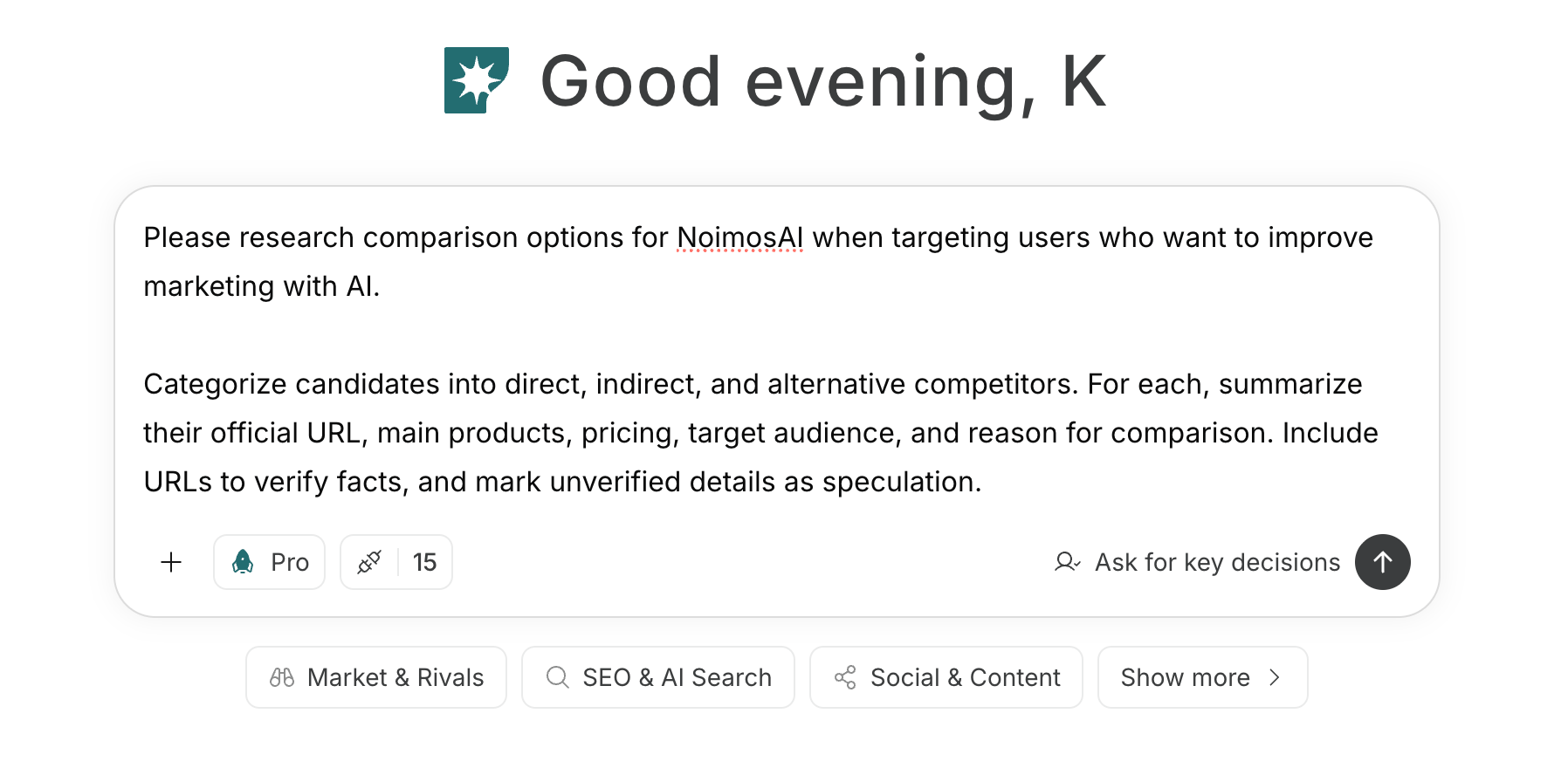
First, enter your topic and target audience in chat and research candidate creators. Include direct peers, creators serving the same audience with adjacent topics, and publishers using a different format. Select only candidates with a clear reason for comparison.
#### Prompt for chat
```text theme={null}
Research candidate creators, blogs, newsletters, video/audio channels, and online media that deliver information on [theme] to [target audience].
Group them into: same audience and same theme; same audience and an adjacent theme; and same theme in a different format. For each candidate, provide the official URL, primary audience, recurring themes, main format, publishing frequency, and reason for comparison. Mark any unverified detail as an assumption.
```
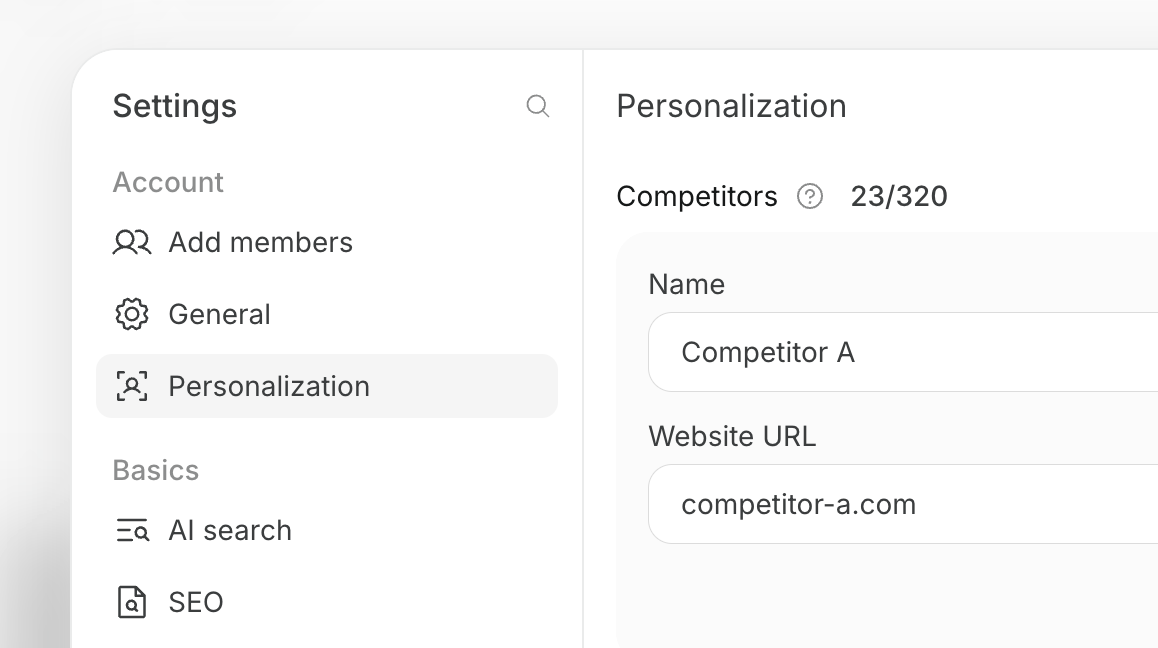
From the candidates, choose 3–5 based on closeness to your audience and theme and potential impact on future planning. For selected targets, open Settings → Personalization in the target’s workspace and register them under Competitors.
If you want to create an agent by telling the agent the purpose and conditions in a prompt, see [Create an agent from chat](/help-center/ai-team/create-a-trigger-from-chat). To manually enter each setting in the configuration screen, see [Create an agent from scratch](/help-center/ai-team/create-an-agent-from-scratch).
### 1. Choose creators and media to compare
First, enter your topic and target audience in chat and research candidate creators. Include direct peers, creators serving the same audience with adjacent topics, and publishers using a different format. Select only candidates with a clear reason for comparison.
#### Prompt for chat
```text theme={null}
Research candidate creators, blogs, newsletters, video/audio channels, and online media that deliver information on [theme] to [target audience].
Group them into: same audience and same theme; same audience and an adjacent theme; and same theme in a different format. For each candidate, provide the official URL, primary audience, recurring themes, main format, publishing frequency, and reason for comparison. Mark any unverified detail as an assumption.
```
From the candidates, choose 3–5 based on closeness to your audience and theme and potential impact on future planning. For selected targets, open Settings → Personalization in the target’s workspace and register them under Competitors.
 ### 2. Analyze published content and audience engagement, then apply the findings
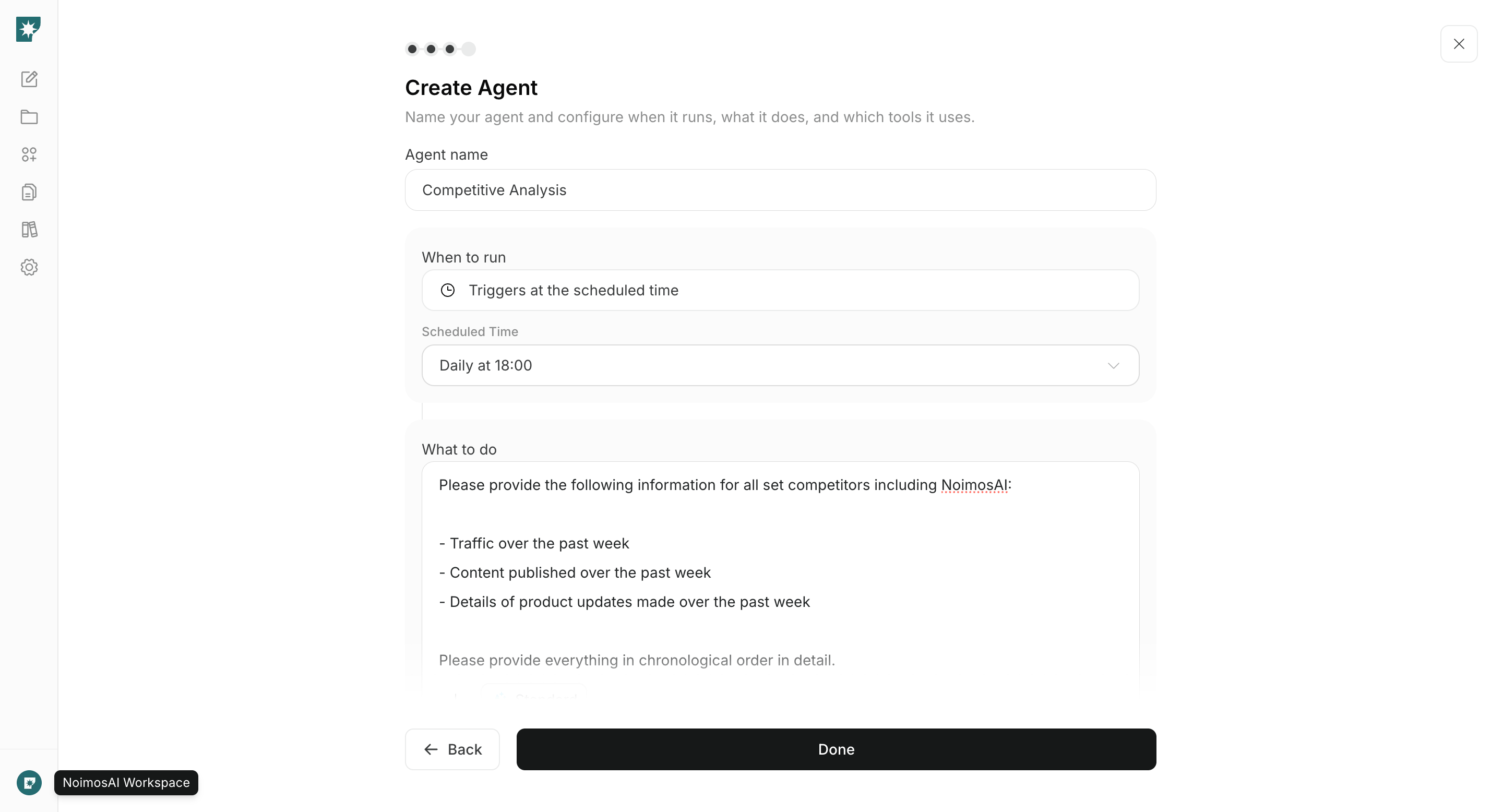
Monitor new published content and reactions from registered creators and media to find themes you haven’t covered and opportunities to add your own unique evidence. Typically run this weekly, or monthly for lower-frequency targets, and create an agent that converts the most important opportunities into plans and final drafts.
#### Agent setup
**Trigger:** Schedule / Weekly
**Instructions:**
```text theme={null}
For the creators, media, and us registered in Personalization, investigate articles, videos, audio, newsletters, and social posts published since the last review.
Organize the following with source URLs and publication dates:
- Themes covered consistently and that have generated audience reactions
- Keywords ranking in search where we still under-serve
- Common characteristics in titles, openings, structure, formats, evidence, and concrete examples
- Gaps we can answer uniquely using our expertise, experience, and primary sources
For the most important opportunity, choose the most suitable format from [article, video outline, audio outline, social post] and create a final draft. Do not mimic content; use only facts we input as the basis.
```
**Integrations:** None
### 2. Analyze published content and audience engagement, then apply the findings
Monitor new published content and reactions from registered creators and media to find themes you haven’t covered and opportunities to add your own unique evidence. Typically run this weekly, or monthly for lower-frequency targets, and create an agent that converts the most important opportunities into plans and final drafts.
#### Agent setup
**Trigger:** Schedule / Weekly
**Instructions:**
```text theme={null}
For the creators, media, and us registered in Personalization, investigate articles, videos, audio, newsletters, and social posts published since the last review.
Organize the following with source URLs and publication dates:
- Themes covered consistently and that have generated audience reactions
- Keywords ranking in search where we still under-serve
- Common characteristics in titles, openings, structure, formats, evidence, and concrete examples
- Gaps we can answer uniquely using our expertise, experience, and primary sources
For the most important opportunity, choose the most suitable format from [article, video outline, audio outline, social post] and create a final draft. Do not mimic content; use only facts we input as the basis.
```
**Integrations:** None
 Review proposed drafts to ensure your experience, research, and opinions are accurately reflected before publishing. After publication, check outcomes appropriate to the format such as search traffic, views, saves, shares, follows, and subscriptions.
#### Turn research results into plans
Don’t leave research results as a list—decide the next actions. Prioritize candidates by three points: relevance to readers, evidence you can uniquely provide, and verifiable outcomes after publication.
| Findings from research | Next actions |
| ---------------------------------------------------------------- | --------------------------------------------------------------------------------------------- |
| Similar media rank high in search but have outdated explanations | Check the original sources and create an article with your verification and concrete examples |
| The same questions are being asked across multiple creators | Create a Q\&A post and a detailed explanatory article or video |
| Only certain parts of long content get reactions | Turn the reacted points into standalone diagrams, short videos, or Q\&As |
| No creators show supporting evidence | Publish verification methods using original research, demonstrations, and primary sources |
| Topics overlap with your existing content | Don’t recreate—update old content with missing concrete examples |
Even if reactions are large, deprioritize items that are not relevant to your target audience or theme. To avoid producing content that merely swaps another’s structure or expression, decide on primary sources to use at the planning stage.
## Related pages
* [Create and improve websites and media](/playbooks/publishing-community/build-media)
* [Grow readership from search with SEO](/playbooks/publishing-community/seo)
* [Manage social media](/playbooks/publishing-community/sns)
Review proposed drafts to ensure your experience, research, and opinions are accurately reflected before publishing. After publication, check outcomes appropriate to the format such as search traffic, views, saves, shares, follows, and subscriptions.
#### Turn research results into plans
Don’t leave research results as a list—decide the next actions. Prioritize candidates by three points: relevance to readers, evidence you can uniquely provide, and verifiable outcomes after publication.
| Findings from research | Next actions |
| ---------------------------------------------------------------- | --------------------------------------------------------------------------------------------- |
| Similar media rank high in search but have outdated explanations | Check the original sources and create an article with your verification and concrete examples |
| The same questions are being asked across multiple creators | Create a Q\&A post and a detailed explanatory article or video |
| Only certain parts of long content get reactions | Turn the reacted points into standalone diagrams, short videos, or Q\&As |
| No creators show supporting evidence | Publish verification methods using original research, demonstrations, and primary sources |
| Topics overlap with your existing content | Don’t recreate—update old content with missing concrete examples |
Even if reactions are large, deprioritize items that are not relevant to your target audience or theme. To avoid producing content that merely swaps another’s structure or expression, decide on primary sources to use at the planning stage.
## Related pages
* [Create and improve websites and media](/playbooks/publishing-community/build-media)
* [Grow readership from search with SEO](/playbooks/publishing-community/seo)
* [Manage social media](/playbooks/publishing-community/sns)