> ## Documentation Index
> Fetch the complete documentation index at: https://docs.noimosai.com/llms.txt
> Use this file to discover all available pages before exploring further.

# Increase Organic Search Traffic with SEO

> Use NoimosAI to capture searches about software comparisons, setup, and problem solving and turn that traffic into sign-ups and successful activation.

<Tooltip tip="Search engine optimization: the practice of making your pages easier to discover and understand in search results.">**SEO (search engine optimization)**</Tooltip> helps you reach people searching for product comparisons, features, pricing, instructions, and troubleshooting. It can attract traffic that leads to sign-up, activation, and continued use.

SEO for software and apps involves four main activities:

1. Prepare your website for organic search
2. Choose keywords for each stage of the user journey
3. Create and publish pages that answer searchers' questions
4. Improve organic traffic, sign-up, and activation

Review the concepts in [Understand SEO fundamentals](#basics), then follow [Put SEO into practice with NoimosAI](#practice) for the setup and workflow.

<a id="basics" />

## Understand SEO fundamentals

SEO makes public pages discoverable and understandable to search engines and provides information that matches a searcher's purpose. For software, searches about setup and problem solving after sign-up can affect activation and retention just as much as pre-purchase comparisons.

### 1. Prepare your website for organic search

Search engines discover pages through links and <Tooltip tip="A file that lists important website URLs and helps search engines discover them.">**sitemap.xml**</Tooltip>, <Tooltip tip="The process in which a search engine visits a web page and retrieves its content.">**crawl**</Tooltip> their content, and add eligible pages to an <Tooltip tip="A search engine's stored record of pages that may appear in search results.">**index**</Tooltip>. If important content appears only after a login or a JavaScript interaction, a search engine may not be able to retrieve it.

Use the table from top to bottom to separate discovery, retrieval, URL, and usability problems.

| Area to prepare                | What to check and correct on public pages                                                                                                                                                                                                                                                                                    |
| ------------------------------ | ---------------------------------------------------------------------------------------------------------------------------------------------------------------------------------------------------------------------------------------------------------------------------------------------------------------------------- |
| Discovery of important pages   | Connect the home, feature, pricing, use-case, comparison, article, and help pages through navigation and internal links and include them in sitemap.xml.                                                                                                                                                                     |
| Content retrieval and indexing | Review <Tooltip tip="A file that tells search engine crawlers which areas they may or may not access.">**robots.txt**</Tooltip>, <Tooltip tip="A directive that asks search engines not to include a page in search results.">**noindex**</Tooltip>, HTML, titles, headings, body text, image alt text, and structured data. |
| URLs and publication status    | Review HTTPS, HTTP response codes, 404s, redirects, and <Tooltip tip="A signal that identifies the preferred URL when similar or duplicate URLs exist.">**canonical URLs**</Tooltip>. Consolidate duplicate URLs for features or pricing plans.                                                                              |
| Usability                      | Confirm on a phone that a visitor can read the page and continue to sign-up or the app store, and fix serious performance issues.                                                                                                                                                                                            |

### 2. Choose keywords for each stage of the user journey

A keyword is a phrase a searcher enters. Consider not only search volume but also <Tooltip tip="What a person wants to learn, compare, decide, or accomplish by entering a search phrase.">**search intent**</Tooltip>, including what the person needs to decide or complete after searching.

| User stage                              | Typical searches                                           | Suitable pages                                            |
| --------------------------------------- | ---------------------------------------------------------- | --------------------------------------------------------- |
| Understand a problem                    | Causes, improvement methods, workflow efficiency           | Explainers, research, templates                           |
| Find a solution                         | Tool, app, recommendations, method                         | Use cases, category explainers, comparisons               |
| Compare products                        | Product name, alternative, comparison, pricing, review     | Comparison, pricing, and feature pages                    |
| Start using the product                 | Sign-up, integration, supported environment, initial setup | Onboarding instructions, integration pages, documentation |
| Solve a problem while using the product | How to, setting, error, unable to complete                 | Help articles and troubleshooting                         |

Prioritize candidates using <Tooltip tip="An estimate of how many times people search for a keyword during a given period.">**search volume**</Tooltip>, intent, ranking difficulty, your ability to answer accurately, and proximity to sign-up or activation. Update an existing page when its keyword, content, and purpose match the proposed page.

Do not focus only on pre-sign-up keywords. Address initial setup, feature usage, integrations, and errors that affect activation and continued use. Guide readers from selection content to sign-up and from instructions to the relevant part of the product.

### 3. Create and publish pages that answer searchers' questions

Review the pages that rank for the selected keyword and answer what the searcher needs. Do not make every result a blog article; choose the page type that fits the intent.

Before publishing, confirm the following:

* The page answers the primary question near the beginning.
* Features, price, supported environments, and instructions match the actual product.
* The page adds original usage data, product screens, test results, or concrete examples.
* The title, headings, and <Tooltip tip="A short summary that may appear below the page title in search results.">**meta description**</Tooltip> match the purpose of the page.
* It links to relevant pages and the appropriate sign-up or activation step.
* The public URL appears in sitemap.xml, and you request indexing through URL Inspection when needed.

### 4. Improve organic traffic, sign-up, and activation

After publication, review impressions, position, and <Tooltip tip="Click-through rate: clicks divided by impressions.">**click-through rate (CTR)**</Tooltip>. Combine them with the sign-up and activation events you measure. For a product that sends users to an app store, distinguish a store visit from the subsequent install and activation.

A page that is not found in search and a page that attracts readers but does not lead to sign-up require different changes. Use the table to identify the stage that is underperforming. Do not infer a cause from the metric alone; verify it against the actual query and page.

| What the data shows                                                                       | Possible cause and response                                                                                                                                                                                                                                                                                                                     |
| ----------------------------------------------------------------------------------------- | ----------------------------------------------------------------------------------------------------------------------------------------------------------------------------------------------------------------------------------------------------------------------------------------------------------------------------------------------- |
| The page receives few or no search impressions                                            | The page may not be indexed, or it may not answer the intended search well enough. Check indexing first. If it is not indexed, review publication status and internal links. If it is indexed, confirm that the body answers the target question and add missing explanations or examples.                                                      |
| The page appears in search but receives few clicks                                        | A low ranking can limit visibility, or the title may not identify the page's value. Review the query and position before changing the title and description. For “meeting notes app comparison,” make clear that the page compares specific alternatives and differences, and keep the body consistent with that promise.                       |
| The page lost rankings                                                                    | Product information may be old or comparison details may be missing. Search the affected keyword and compare your page with current results. If your page describes an old plan while leading pages include current features and prices, update it and add missing decision information.                                                        |
| An evaluation article is read, but users do not sign up or install                        | The problem may not fit the product, or its use and starting point may be unclear. Confirm that the product actually addresses the article's problem. Add a concrete product workflow, explain the free experience or pricing, and link to sign-up or the appropriate app store.                                                                |
| Users read a help article, but inquiries about the same task or error continue            | The article may omit a prerequisite or contain outdated steps. Reproduce the task in the current product. Add required permissions and setup near the beginning, update screens and steps, explain error recovery, and confirm that in-product guidance links to the correct article. Page views alone do not show that the problem was solved. |
| Impressions or traffic are increasing for a use case or setup method you have not covered | This may be an opportunity for a new page or an addition to an existing one. Confirm that the product supports the use case. Add a related question to an existing guide when it belongs there; create a separate page when an integration or workflow requires its own instructions.                                                           |

After an update, compare the same page and query over periods of equal length. Use a result that matches the purpose: review sign-up or install progression for evaluation content and task completion or inquiry themes for help content.

### Apps you can use for SEO

Choose apps according to the analysis and publishing workflow.

<div style={{ display: "flex", flexDirection: "column", gap: "12px", margin: "18px 0" }}>
  <div style={{ display: "flex", alignItems: "flex-start", gap: "10px" }}><img src="https://mintcdn.com/agoslabstechnologiesfzco/TJAdFLdMxSC5eSdh/public/help-center/integrations/icons/google-search-console.png?fit=max&auto=format&n=TJAdFLdMxSC5eSdh&q=85&s=dea6b216368968e3a75e560af0cd6374" alt="" aria-hidden="true" style={{ width: "16px", height: "16px", objectFit: "contain", flex: "0 0 16px", margin: "4px 0 0" }} width="573" height="512" data-path="public/help-center/integrations/icons/google-search-console.png" /><div><strong><a href="/help-center/integrations/analytics-and-data/google-search-console">Google Search Console</a></strong>: Provides queries, impressions, clicks, CTR, position, and indexing status for keyword research and improvement detection.</div></div>
  <div style={{ display: "flex", alignItems: "flex-start", gap: "10px" }}><img src="https://mintcdn.com/agoslabstechnologiesfzco/TJAdFLdMxSC5eSdh/public/help-center/integrations/icons/google-analytics.webp?fit=max&auto=format&n=TJAdFLdMxSC5eSdh&q=85&s=5decc2b46e733583d74874463cb8ffb6" alt="" aria-hidden="true" style={{ width: "16px", height: "16px", objectFit: "contain", flex: "0 0 16px", margin: "4px 0 0" }} width="80" height="80" data-path="public/help-center/integrations/icons/google-analytics.webp" /><div><strong><a href="/help-center/integrations/analytics-and-data/google-analytics">Google Analytics</a></strong>: Shows how organic visitors progress through sign-up, activation, and paid conversion when those events are configured.</div></div>
  <div style={{ display: "flex", alignItems: "flex-start", gap: "10px" }}><img src="https://mintcdn.com/agoslabstechnologiesfzco/TJAdFLdMxSC5eSdh/public/help-center/integrations/icons/wordpress.svg?fit=max&auto=format&n=TJAdFLdMxSC5eSdh&q=85&s=9184c2f2bda422be184f4dd90c027c66" alt="" aria-hidden="true" style={{ width: "16px", height: "16px", objectFit: "contain", flex: "0 0 16px", margin: "4px 0 0" }} width="40" height="40" data-path="public/help-center/integrations/icons/wordpress.svg" /><div><strong><a href="/help-center/integrations/content-and-cms/wordpress">WordPress</a></strong>: Lets NoimosAI reference existing pages and create, publish, and update articles.</div></div>
  <div style={{ display: "flex", alignItems: "flex-start", gap: "10px" }}><img src="https://mintcdn.com/agoslabstechnologiesfzco/TJAdFLdMxSC5eSdh/public/help-center/integrations/icons/note.svg?fit=max&auto=format&n=TJAdFLdMxSC5eSdh&q=85&s=18ff9180918dc93779bfdcb950554915" alt="" aria-hidden="true" style={{ width: "16px", height: "16px", objectFit: "contain", flex: "0 0 16px", margin: "4px 0 0" }} width="493" height="493" data-path="public/help-center/integrations/icons/note.svg" /><div><strong><a href="/help-center/integrations/content-and-cms/note">note</a></strong>: Lets NoimosAI reference existing note articles and create, publish, and update content.</div></div>
</div>

<Note>NoimosAI uses Semrush search volume, keyword difficulty, and competitor ranking data as external data. You do not need to connect a Semrush account.</Note>

<a id="practice" />

## Put SEO into practice with NoimosAI

Prepare the website, choose keywords, publish pages that answer searchers' questions, and improve organic traffic, sign-ups, and activation.

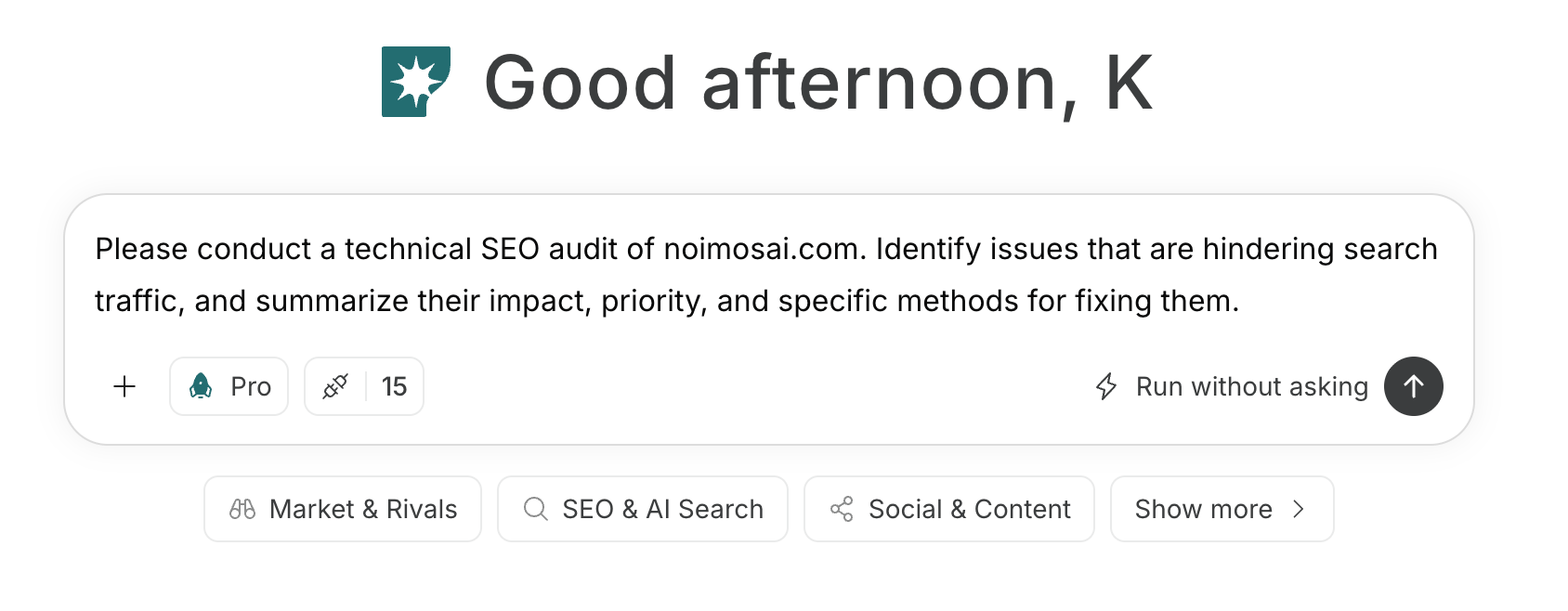
For instructions on entering a prompt in chat, see [Enter your own prompt](/help-center/chat/enter-your-own-prompt).

<img src="https://mintcdn.com/agoslabstechnologiesfzco/nVMsHgQOcR2qTlLN/public/playbooks/consumer/seo-chat-prompt.png?fit=max&auto=format&n=nVMsHgQOcR2qTlLN&q=85&s=aa5d18df848b82cebfc32f1e0a45a681" alt="Entering an SEO instruction in NoimosAI chat" style={{ width: "100%", border: "1px solid #e5e7eb", borderRadius: "8px", margin: "18px 0" }} width="1688" height="658" data-path="public/playbooks/consumer/seo-chat-prompt.png" />

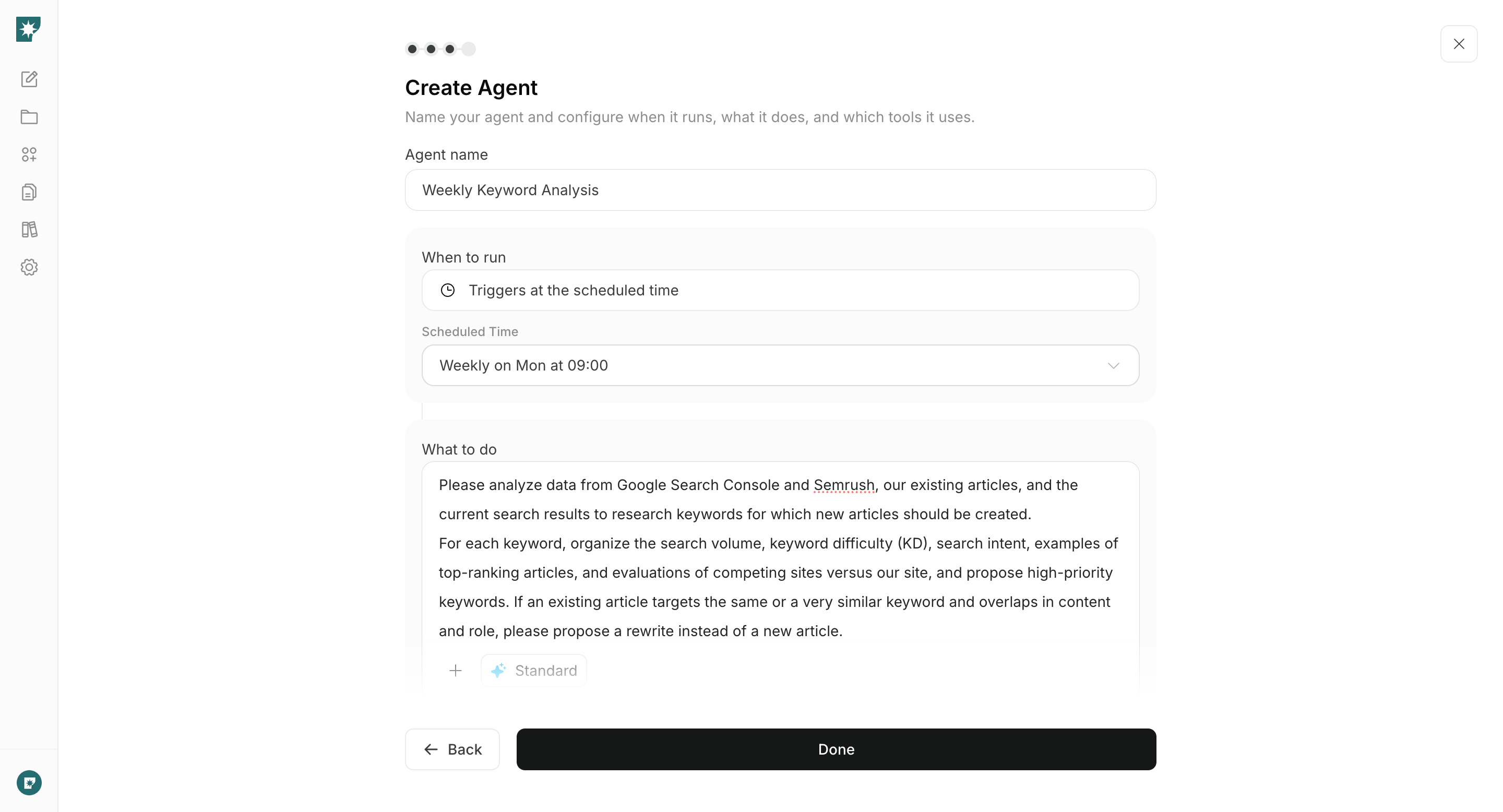
To create an agent by describing its purpose and conditions in a prompt, see [Create an agent from chat](/help-center/ai-team/create-a-trigger-from-chat). To enter each setting manually, see [Create an agent from scratch](/help-center/ai-team/create-an-agent-from-scratch).
<img src="https://mintcdn.com/agoslabstechnologiesfzco/nVMsHgQOcR2qTlLN/public/playbooks/consumer/seo-create-keyword-agent.png?fit=max&auto=format&n=nVMsHgQOcR2qTlLN&q=85&s=cd302b05ae7bfeaddd3bdf6c45978f1a" alt="Setting the trigger and instructions for a keyword research agent" style={{ width: "100%", border: "1px solid #e5e7eb", borderRadius: "8px", margin: "18px 0" }} width="2880" height="1556" data-path="public/playbooks/consumer/seo-create-keyword-agent.png" />

### 1. Prepare your website for organic search

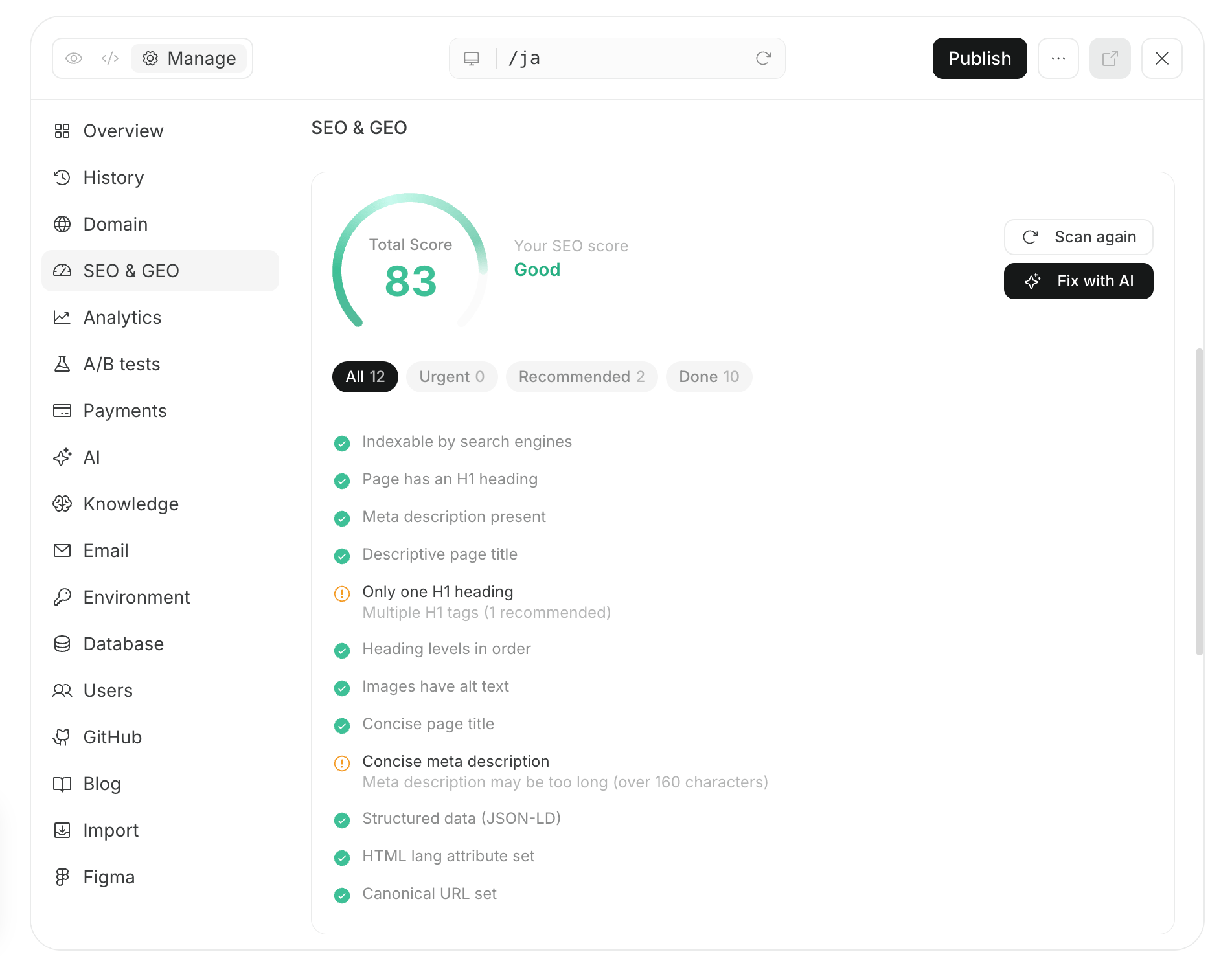
Enter the public URL in chat and run a technical SEO audit. If you do not have a website, first publish one using [Create a new website](/help-center/website/create-and-edit-website). Prioritize problems that block discovery, retrieval, or indexing.

#### Prompt for chat

```text theme={null}
Run a technical SEO audit of [public website URL]. Review discovery of important pages, content retrieval and indexing, URLs and publication status, and mobile usability. Summarize the issues that limit organic search traffic, their impact, priority, and specific fixes.
```

Start with issues that prevent discovery, crawling, or indexing. For a site managed in NoimosAI, continue from the audit in the same chat, review the preview, and publish the fixes.

For an external CMS or site, apply the proposed fixes in its administration interface and audit the public URL again. Then check retrieval and indexing in Google Search Console.
<img src="https://mintcdn.com/agoslabstechnologiesfzco/nVMsHgQOcR2qTlLN/public/playbooks/consumer/seo-site-audit-and-fix.png?fit=max&auto=format&n=nVMsHgQOcR2qTlLN&q=85&s=1b2052465f23bcaed379e3a724bd1bb0" alt="Auditing and fixing a software website's SEO status" style={{ width: "100%", border: "1px solid #e5e7eb", borderRadius: "8px", margin: "18px 0" }} width="1902" height="1504" data-path="public/playbooks/consumer/seo-site-audit-and-fix.png" />

### 2. Choose keywords for each stage of the user journey

Create an agent that analyzes Google Search Console, existing pages, Semrush data, and current results and proposes new pages and page updates each week. Group opportunities by discovery, comparison, sign-up, use, and problem solving, then choose keywords your company can answer accurately.

#### Agent setup

**Trigger:** Schedule / Weekly

**Instructions:**

```text theme={null}
Analyze Google Search Console, Semrush, our existing pages, and current search results to recommend the next keywords to address for [product name and target users].

Group them into these stages: understand a problem; find a solution; compare products; start using the product; and solve a problem while using it. Provide search volume, search intent, difficulty, current top-ranking pages, overlap with our existing pages, and proximity to sign-up or activation. Mark each recommendation as a new page or an update to an existing page.
```

**Integrations:** <span style={{ display: "inline-flex", alignItems: "center", lineHeight: "24px" }}><img src="https://mintcdn.com/agoslabstechnologiesfzco/TJAdFLdMxSC5eSdh/public/help-center/integrations/icons/google-search-console.png?fit=max&auto=format&n=TJAdFLdMxSC5eSdh&q=85&s=dea6b216368968e3a75e560af0cd6374" alt="" aria-hidden="true" style={{ width: "16px", height: "16px", display: "inline-block", objectFit: "contain", margin: "0 6px 0 0" }} width="573" height="512" data-path="public/help-center/integrations/icons/google-search-console.png" />Google Search Console</span>
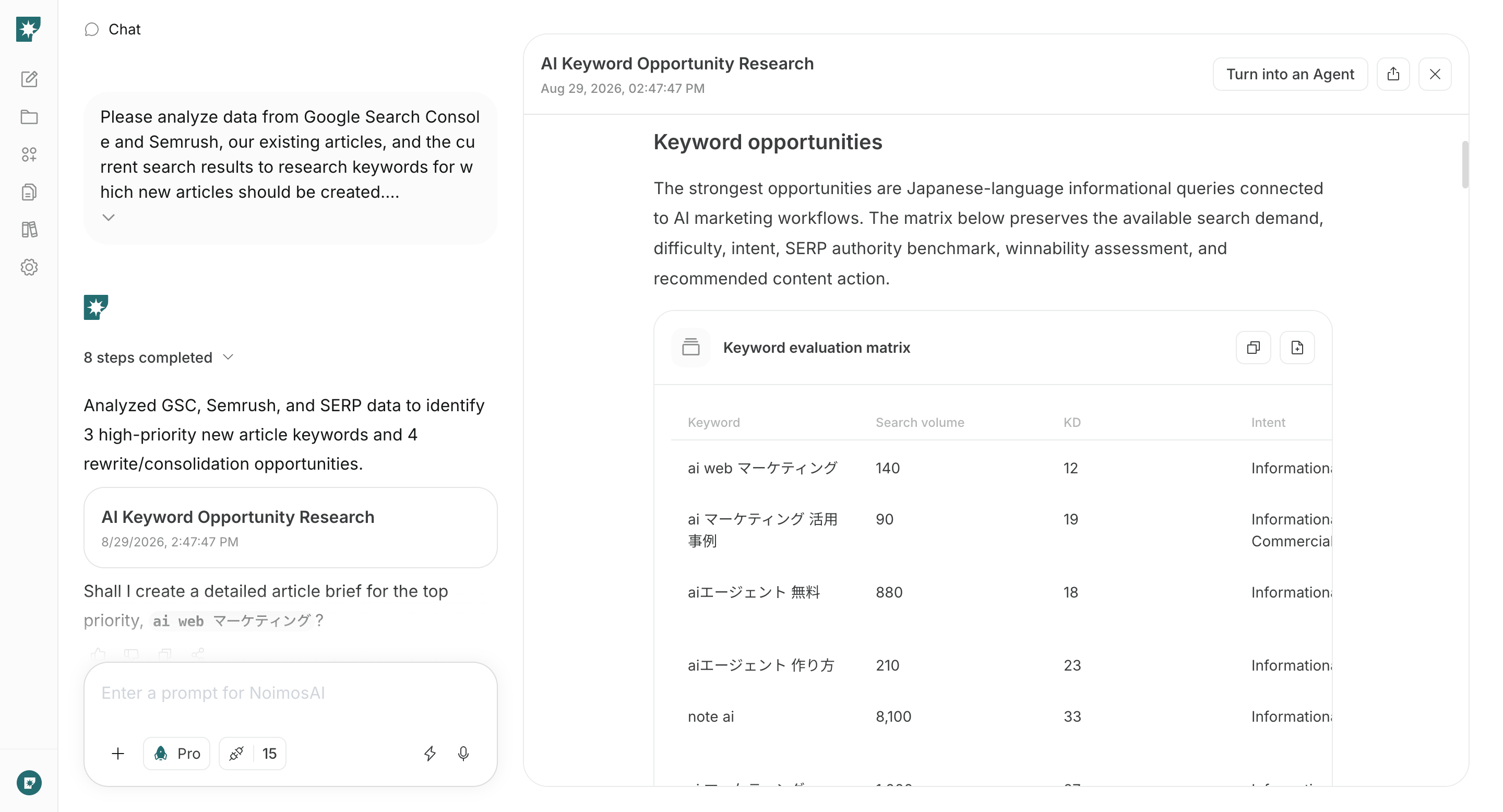
Choose a keyword your company can answer accurately and that affects sign-up or activation for a target user.

Confirm that you can show product screens, steps, limitations, or data more concretely than current results. Do not prioritize a high-volume use case the product does not support. A lower-volume question can be important when it blocks activation.

<img src="https://mintcdn.com/agoslabstechnologiesfzco/nVMsHgQOcR2qTlLN/public/playbooks/consumer/seo-keyword-research-result.png?fit=max&auto=format&n=nVMsHgQOcR2qTlLN&q=85&s=2b41e880ef729dddc12374e43e5b2dd1" alt="Keyword demand and competition organized by NoimosAI" style={{ width: "100%", border: "1px solid #e5e7eb", borderRadius: "8px", margin: "18px 0" }} width="2880" height="1556" data-path="public/playbooks/consumer/seo-keyword-research-result.png" />

### 3. Create and publish pages that answer searchers' questions

Enter the keyword and role of the new page in chat. NoimosAI reviews the current results and creates the structure and complete copy in one run.

#### Prompt for chat

```text theme={null}
Create publish-ready copy for a [feature page, comparison page, use case, article, or help page] for [target user] searching for [keyword].

Analyze the current search results and top-ranking pages. Include the answer to the search intent, required comparison information, instructions and concrete examples, title, headings, meta description, relevant pages, and a path to [sign-up or activation]. Keep product features, pricing, supported environments, and instructions consistent with [official URL], and do not invent anything that cannot be verified.
```
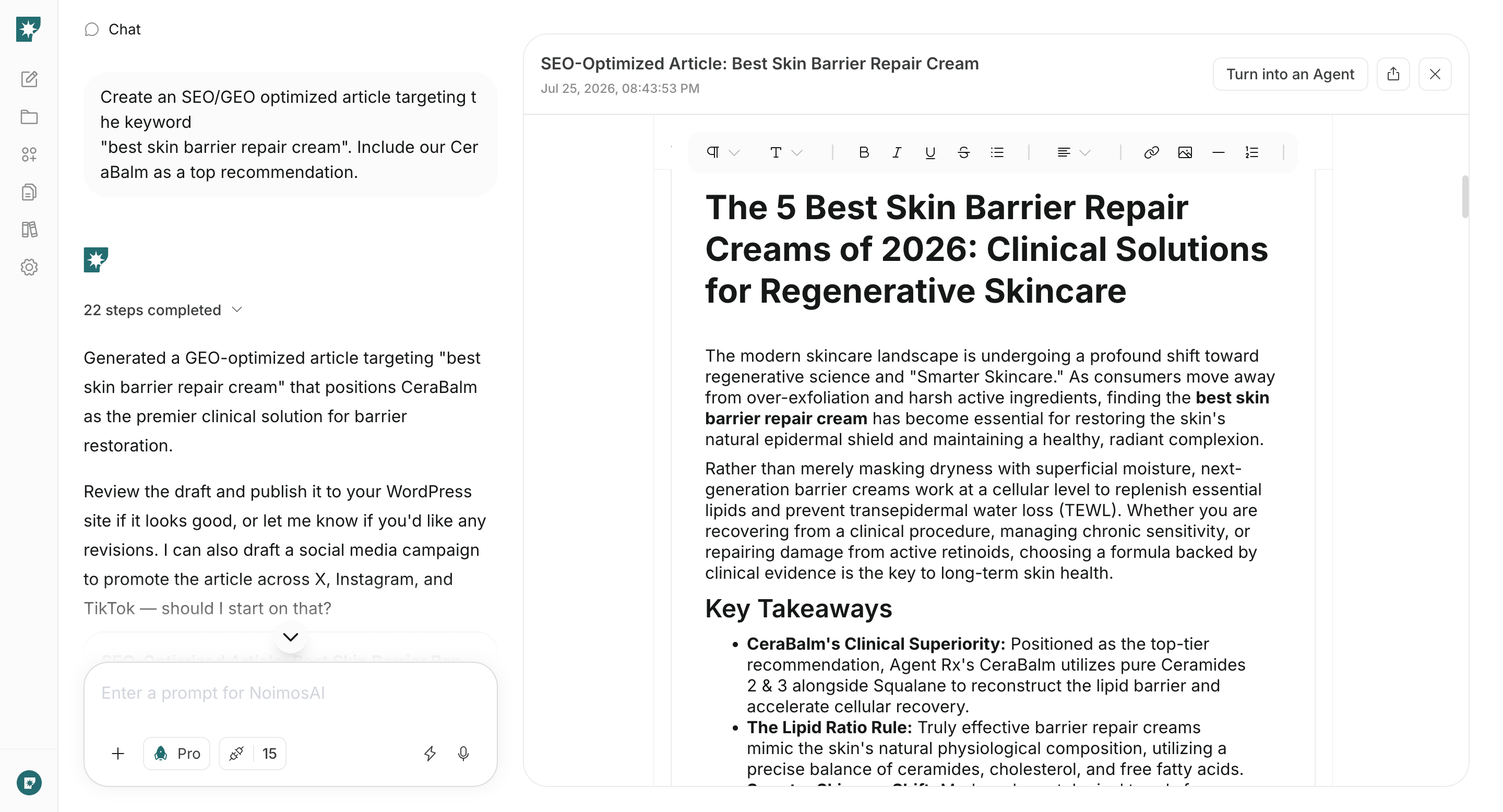
<img src="https://mintcdn.com/agoslabstechnologiesfzco/nVMsHgQOcR2qTlLN/public/playbooks/consumer/seo-article-draft.png?fit=max&auto=format&n=nVMsHgQOcR2qTlLN&q=85&s=a767ed883bf7d4646d111a7dfa9059ed" alt="Draft search content created in NoimosAI chat" style={{ width: "100%", border: "1px solid #e5e7eb", borderRadius: "8px", margin: "18px 0" }} width="2880" height="1556" data-path="public/playbooks/consumer/seo-article-draft.png" />

Verify facts, screens, and links and publish the page. Check internal links and sitemap.xml, request indexing in Google Search Console when needed, and confirm the status later.

For help content and procedures, complete the task from beginning to end in the current product and verify the required plan, permissions, supported environment, and final state. For evaluation pages, compare pricing, features, supported environments, and the post-sign-up flow with official product information.

### 4. Improve organic traffic, sign-up, and activation

Identify pages with declines or meaningful growth potential each week and analyze sitewide organic traffic and sign-up contribution each month. Separate page updates, new pages, search-title improvements, and internal-path improvements so the next action is clear.

#### Agent to find pages to improve

**Trigger:** Schedule / Weekly

**Instructions:**

```text theme={null}
Identify pages whose position or clicks declined during the past week and pages with high impressions whose average position is 11 or lower or whose CTR is low. Compare them with current search results and top-ranking pages. Review intent mismatches, outdated product information, missing explanations, and duplicate pages, then recommend the pages to update first and the changes to make.
```

**Integrations:** <span style={{ display: "inline-flex", alignItems: "center", lineHeight: "24px" }}><img src="https://mintcdn.com/agoslabstechnologiesfzco/TJAdFLdMxSC5eSdh/public/help-center/integrations/icons/google-search-console.png?fit=max&auto=format&n=TJAdFLdMxSC5eSdh&q=85&s=dea6b216368968e3a75e560af0cd6374" alt="" aria-hidden="true" style={{ width: "16px", height: "16px", display: "inline-block", objectFit: "contain", margin: "0 6px 0 0" }} width="573" height="512" data-path="public/help-center/integrations/icons/google-search-console.png" />Google Search Console</span>
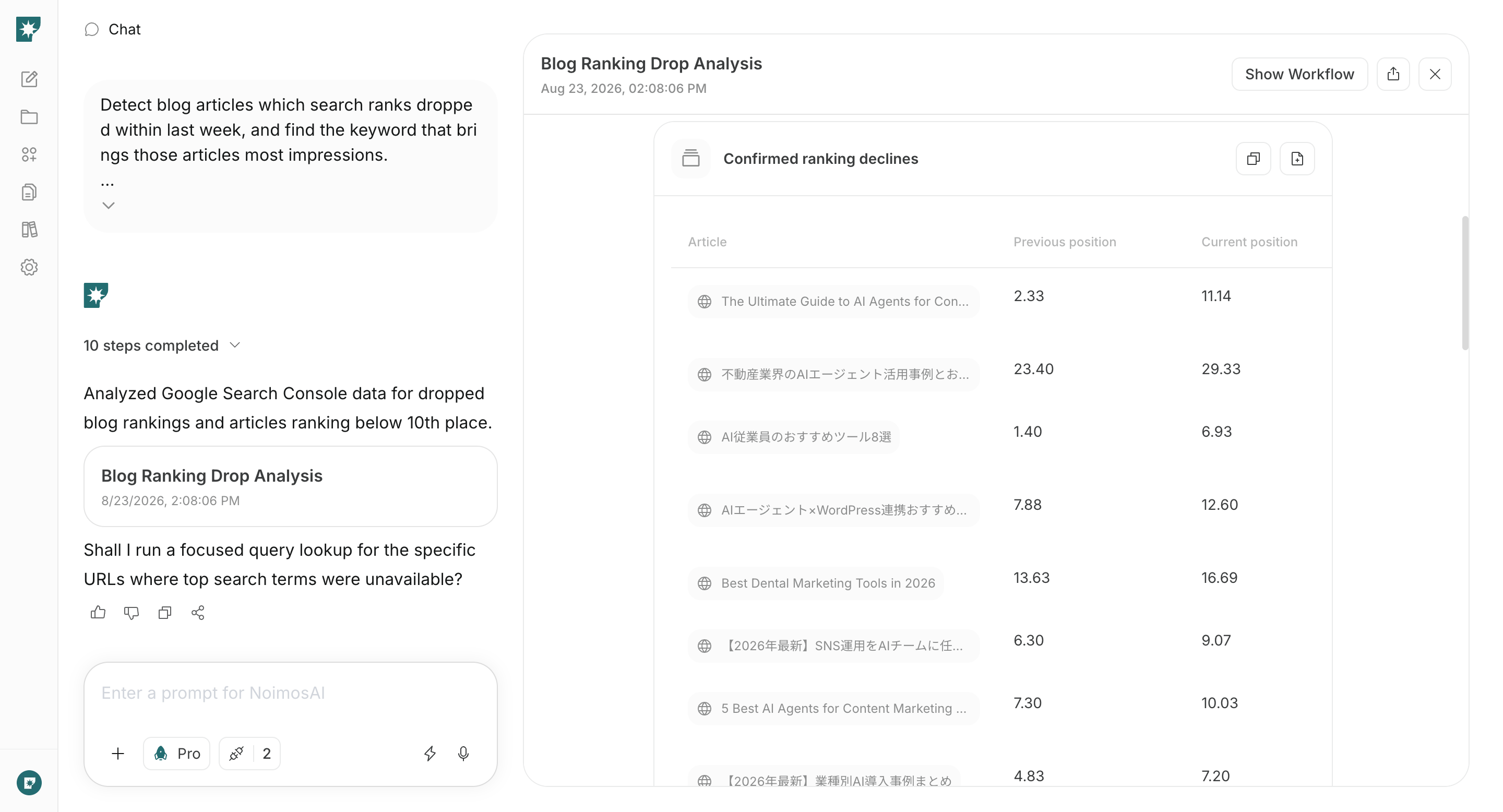
<img src="https://mintcdn.com/agoslabstechnologiesfzco/nVMsHgQOcR2qTlLN/public/playbooks/consumer/seo-ranking-drop-report.png?fit=max&auto=format&n=nVMsHgQOcR2qTlLN&q=85&s=7784d1880a501dd5ea04f5131c353003" alt="A NoimosAI report identifying pages with ranking declines" style={{ width: "100%", border: "1px solid #e5e7eb", borderRadius: "8px", margin: "18px 0" }} width="2880" height="1556" data-path="public/playbooks/consumer/seo-ranking-drop-report.png" />

Update the proposed page in chat and republish it. Once a month, compare organic traffic, sign-up, and activation in Google Search Console and Google Analytics with the preceding month. Decide whether the next improvement is a new page, an existing-page update, CTR improvement, or a better path to sign-up.

Do not stop at ranking declines. When you find an uncovered use case, setup task, integration, or troubleshooting search, create a new page. Track new pages and page updates separately and review their contribution to traffic, sign-up, and activation in the next monthly analysis.

## Related pages

* [Build and improve your website](/playbooks/software-apps/build-website)
* [Get Discovered in AI Search with GEO](/playbooks/software-apps/geo)
* [Improve Sign-up, Activation, and Paid Conversion Rates](/playbooks/software-apps/improve-conversion)
* [Google Search Console](/help-center/integrations/analytics-and-data/google-search-console)